

Affiliate disclosure: This post contains affiliate links. If you buy through them, I may earn a small commission — at no extra cost to you. I only recommend pieces I'd point a friend to, and my editorial opinions are my own. Full disclosure here.
You take off a ring after a long, sweaty day and there's a green band where it sat. It feels like a sign the jewelry is "cheap" or that you're allergic to it — but as a former cosmetic chemist, I can tell you it's neither, exactly. Jewelry turns your skin green for one main reason: copper. When the copper in a piece (or in its alloy) meets the acids and salts in your sweat, it oxidizes and forms green copper salts that rub off onto your skin. The good news is it's harmless, and the better news is that it's completely avoidable once you know which metals contain reactive copper and which don't. This guide explains the chemistry in plain English, then ranks the metals that won't turn your skin green.
Key Takeaways
- Copper is the culprit. Green skin is copper reacting with sweat, acids and salt to form green copper salts (verdigris). It is a surface reaction and, per Genesis HealthCare System, "not dangerous, so don't worry."
- It's not a nickel allergy. Green staining (copper) and an itchy red rash (a nickel allergy) are two different reactions with two different metals — people confuse them constantly.
- Truly green-proof: solid gold and titanium. Neither contains exposed copper, so neither can stain your skin. Solid gold is also water-inert; implant-grade titanium is also nickel-free.
- The accessible everyday pick: a copper-free steel core. 316L surgical stainless steel has no copper, so even if a gold-tone finish wears, the base won't green your skin — the budget way to avoid the problem entirely.
- Watch out for brass, bronze, and low-quality "gold." Brass is a copper alloy; most pieces that stain are gold-plated brass where the thin plating has worn through to the copper underneath.
Why jewelry turns your skin green: the chemistry
Copper is a wonderfully useful metal — it's cheap, soft enough to shape, and it gives gold-tone alloys their warm color. It's also reactive. When copper is exposed to oxygen, moisture, and the mild acids and salts in your sweat, it undergoes oxidation. The Royal Society of Chemistry describes how copper reacts with sweat to form chelates, and with salt water to form chlorides, building up a thin blue-green layer of copper carbonate called verdigris (the same patina that turns the Statue of Liberty green). Because that layer is thin and powdery, it transfers straight onto your skin.
Two things make it worse for some people than others. The first is your own sweat chemistry — more acidic sweat, hot climates, exercise and stress all speed copper oxidation up. The second is what you put on your skin: lotions, sunscreen, soap and perfume all contain ingredients that accelerate the reaction, which is exactly why I tell people to apply skincare first and let it dry before putting jewelry on. Genesis HealthCare System sums it up plainly: the green is "a chemical reaction from the metal in your jewelry and the sweat on your skin," and "it's not dangerous, so don't worry."
Green skin is not a metal allergy
This is the single most common mix-up I see, so it's worth being precise. Green staining is a copper reaction — cosmetic, harmless, washes off. An allergic reaction is usually nickel — an itchy, red, sometimes blistering rash (allergic contact dermatitis) that appears where the metal touched you. They're different metals causing different problems. The American Academy of Dermatology notes that more than 18 percent of people in North America are allergic to nickel, and that "earrings, earring backs and watches are some of the biggest culprits." So a piece can green your skin (copper) without being allergenic, or trigger a rash (nickel) without ever staining. The fix for both, conveniently, is the same: choose a metal with neither problem. If the itchy-rash side is your concern, I cover it in depth in my guide to hypoallergenic earrings for sensitive ears.
Metals that turn skin green vs. metals that won't
Here's the whole landscape at a glance — ranked by how reliably each metal avoids greening your skin, with the real reason why.
| Metal | Turns skin green? | Why | Nickel-safe? | From |
|---|---|---|---|---|
| Copper / brass / bronze | Yes, readily | Copper oxidizes with sweat to green salts | Varies | — |
| Gold-plated brass | Eventually | Thin gold wears through to copper core | Varies | — |
| Solid gold (14k+) | No | Noble metal; no exposed copper to react | Yes (18k+) | ~$200+ |
| Gold-filled (14k) | Very rarely | Thick bonded gold seals the brass core | Usually | $62 |
| Titanium (ASTM F-136) | No | No copper, no nickel in the alloy | Yes | $44 |
| 316L stainless steel | No | Iron/chromium alloy — contains no copper | Yes (low release) | $29 |
| Sterling silver (925) | Occasionally | 7.5% copper can tarnish/react; usually nickel-free | Usually | Varies |
1. Solid gold — physically can't turn skin green (Mejuri)
Mejuri Solid 14k Gold
The only category here that is chemically incapable of greening your skin, because there is no exposed copper to oxidize. The trade-off is price, and the easy mistake of buying their vermeil tier instead of the solid line.
Check price at Mejuri →If you want a piece that is chemically incapable of greening your skin, you want solid gold. Gold is a noble metal — it doesn't react with oxygen, water or sweat — and a solid 14k or 18k piece has no exposed copper at the surface to oxidize. (Yes, 14k gold is alloyed with other metals for strength, but those are dispersed through a piece that is overwhelmingly inert gold, not a thin shell over a copper core.) Mejuri is the cleanest mainstream place to buy it, and their own guidance is blunt: "Solid gold won't rust or corrode in water."
Two honest caveats. First, price: solid gold starts around $200 and climbs. Second — and this trips people up constantly — Mejuri's vermeil tier is a different product: a 2.5-micron layer of 18k gold over sterling silver. It's nicer than ordinary plating, but the brand still warns that gold plating "can wear off with repeated exposure to water." Buy the solid line if "never think about it again" is the goal.
- Pros: truly inert — can't green skin, can't tarnish, can't corrode in water; lifetime heirloom piece; nickel-safe at 18k+.
- Cons: the most expensive option by far; easy to accidentally buy the cheaper vermeil tier, which is plated.
2. Gold-filled — the thrifty way to keep copper off your skin (LucyKitty)
LucyKitty 14k Gold-Filled Snake Chain
The smart middle path: real gold thick enough to keep the brass core from reaching your skin, at a fraction of solid-gold pricing. Honest caveat — gold-filled is highly tarnish-resistant but, as the brand itself notes, “not completely immune.”
Check price at LucyKitty →Gold-filled is the most misunderstood category in jewelry, and it's the sweet spot for this exact problem. It does have a brass (copper-alloy) core — but a thick layer of real gold is mechanically bonded to that core under heat and pressure, and U.S. labeling rules require gold-filled to contain a meaningful amount of gold by weight (about 5%, an order of magnitude more than plating). Because the gold shell is so much thicker, it doesn't wear through in normal use, so the copper underneath never reaches your skin. LucyKitty markets its 14k gold-filled chains as "Tarnish-Resistant, Waterproof, Hypoallergenic," and says "with proper care, gold-filled pieces can last for decades."
I like gold-filled because it's honest about what it is. The brand itself notes gold-filled is "highly resistant to tarnish, but it's not completely immune" — which is exactly the right way to talk about a coating, however thick. For most people who green easily but can't justify solid gold, this is the pick.
- Pros: thick bonded gold keeps the brass core sealed away; far more durable than plating; warm real-gold color; usually nickel-free.
- Cons: still has a copper-alloy core (greening is possible if it's ever worn through to bare metal); pricier than steel.
3. Titanium — no copper, no nickel, no drama (Grayling)
Grayling Solitaire Titanium Flat-Back Earrings
The safest choice for genuinely reactive skin: implant-grade titanium has neither the copper that greens skin nor the nickel that triggers allergies. Less of a “fashion” catalog than the others, but unbeatable on biocompatibility.
Check price at Grayling →If your skin reacts to everything — greening, redness, the works — implant-grade titanium is the safest material on this page. Grayling designs exclusively in ASTM F-136 titanium, which it states is "free from cadmium, lead, and nickel." That matters twice over: no copper means it can't green your skin, and no nickel means it won't trigger the allergic rash that affects 18%+ of people. It's the same grade of titanium used in surgical implants and freshly pierced ears, so it's the choice I'd point a genuinely reactive friend to first. The Solitaire Round Titanium Flat-Back Earrings start around $44.
- Pros: contains neither copper nor nickel — green-proof and the lowest allergy risk here; biocompatible (implant-grade); lightweight.
- Cons: ranges skew toward piercing/flat-back styles rather than broad fashion jewelry; gray-toned, not gold (unless coated).
4. 316L stainless steel — the accessible everyday pick (Stylr)

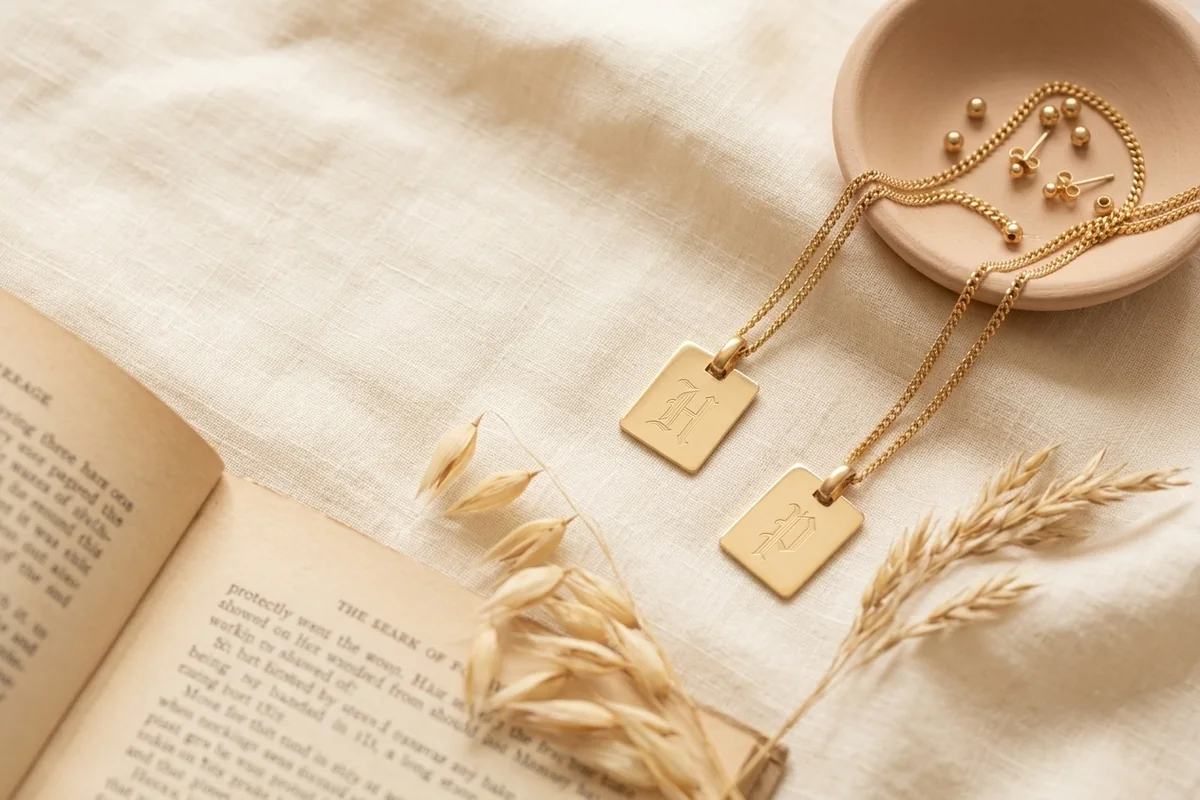
Stylr Hypoallergenic Old English Initial Tag Necklace
The accessible everyday pick: a copper-free 316L core means no green skin even as the finish ages, and the PVD-bonded gold tone is far harder than ordinary plating. It is still a coated piece (not solid gold), but for $29 with a copper-free base it punches above its price.
Check price at Stylr →Here's the part most "won't turn green" roundups miss. The reason cheap gold-plated jewelry greens your skin is the copper-alloy base under the plating — once the thin gold wears through, you're wearing copper. Quality 316L surgical stainless steel sidesteps that entirely, because 316L is an iron-chromium-nickel-molybdenum alloy with no copper in it. So even if a gold-tone finish on a steel piece eventually ages, the metal underneath is still copper-free and won't stain your skin — a fundamentally different situation from plated brass.
Stylr's Hypoallergenic Old English Initial Tag Necklace is a good, cheap example of the category: 18K gold applied by PVD over a 316L steel base, $29, with the brand stating "no base metal exposed means honest, lasting shine" and a 1-year color warranty. I'm ranking it as the accessible everyday option, not above solid gold, and I want to be precise about why: the gold tone here is still a coating (a hard, PVD-bonded one, but finite), so it can't claim solid gold's permanence. What it can claim is the thing this article is actually about — a copper-free core that will not turn your skin green at this price. Stylr is also transparent about nickel: its own FAQ notes 316L is "10–14% nickel by composition" but that the nickel is bound in the alloy with release "well below EU REACH limits," which lines up with the dermatology consensus below.
- Pros: copper-free 316L core (no greening, even as the finish ages); hard PVD gold tone far tougher than ordinary plating; genuinely budget ($29); 1-year color warranty; nickel release stays low.
- Cons: the gold tone is a coating, not solid gold, so the color is finite; 316L is "nickel-safe," not literally nickel-free (titanium wins for the most extreme nickel sensitivity); a younger brand without a long independent track record yet.
How to buy jewelry that won't turn your skin green
The whole decision comes down to one question: is there reactive copper that can reach my skin? Here's the materials-science short version.
Avoid bare copper, brass and bronze for anything you'll sweat in. They're all copper-based, so greening isn't a defect — it's the metal doing exactly what copper does. The most common offender isn't pure copper, though; it's gold-plated brass, where a micron-thin gold flash wears off and exposes the copper core. If a "gold" piece costs a few dollars and doesn't name its base metal, assume plated brass.
Solid gold and titanium are green-proof by composition. Solid 14k+ gold has no exposed copper and is a noble metal; ASTM F-136 titanium contains no copper (or nickel) at all. Neither can stain you. They're the two materials I trust without an asterisk.
316L stainless steel is the budget hero, because it has no copper. Its corrosion resistance comes from a self-repairing chromium-oxide film, and peer-reviewed work describes how that passive oxide layer re-passivates to suppress pitting. The practical upshot for skin: no copper in the alloy means no green stain, full stop.
Know the legal words, because they signal the base metal. The U.S. FTC defines "vermeil" in 16 CFR Part 23 as a sterling-silver base coated with at least 2.5 microns of ≥10k gold — sterling, not brass, so vermeil greens far less than plated brass even though it's still a coating. "Gold-filled" requires a much thicker bonded gold layer than "gold-plated," which is why gold-filled rarely greens and cheap gold-plate eventually does. And on sterling silver: quality 925 is 92.5% silver with 7.5% copper, so it can occasionally react or tarnish, but reputable sterling (Pandora, for instance, states its alloys are "certified by the supplier not to contain nickel, cadmium or other metals potentially recognized as toxic or allergenic") is a fine, mostly green-resistant choice. If a brand names its metal, it's usually telling you it has nothing to hide.
Frequently asked questions
It's copper. When the copper in a piece — or in the brass core under cheap gold plating — meets the acids and salts in your sweat, it oxidizes into green copper salts (the same verdigris that turns old statues green). That thin green layer rubs off onto your skin. It happens faster with acidic sweat, heat, exercise, and lotions or perfume that speed the reaction along.
No. It's a harmless surface reaction between copper and your skin chemistry — Genesis HealthCare System describes it as "not dangerous, so don't worry." It washes off with soap and water. The only thing to watch for is an itchy, red, persistent rash, which is a different problem (usually a nickel allergy) and not the same as cosmetic green staining.
Any metal without exposed copper. Solid gold (14k and up) and ASTM F-136 titanium are green-proof by composition. 316L stainless steel contains no copper, so it won't green your skin either. 14k gold-filled rarely greens because its thick bonded gold layer keeps the brass core sealed. The materials that do green are bare copper, brass, bronze, and gold-plated brass once the thin plating wears through.
Occasionally, yes. Sterling silver is 92.5% silver and 7.5% copper, and that small amount of copper can react with sweat or tarnish over time, sometimes leaving a faint mark. It's far less prone to greening than brass, and quality 925 is usually nickel-free, but it's not as inert as solid gold or titanium. Keeping it dry and clean minimizes any reaction.
No — they're two different reactions with two different metals. Green staining is copper oxidizing on your skin: cosmetic and harmless. An allergy is usually your immune system reacting to nickel, producing an itchy red rash (allergic contact dermatitis) where the metal touched you. The American Academy of Dermatology says more than 18 percent of North Americans are nickel-allergic. Choosing solid gold, titanium or 316L steel avoids both problems at once.
This explainer is part of my complete guide to everyday jewelry that survives real life. If you want gold-tone pieces specifically, see my picks for the best affordable gold-tone jewelry that won't tarnish, and if the itchy-rash side is your real concern, read my guide to hypoallergenic earrings for sensitive ears.