

Affiliate disclosure: This post contains affiliate links. If you buy through them, I may earn a small commission — at no extra cost to you. I only recommend products I'd point a friend to, and my editorial opinions are my own. Full disclosure here.
Expressing milk is the hard part; not wasting it is the part nobody warns you about. As a former cosmetic chemist, I think about breast milk the way I'd think about any biological sample — it has a shelf life that depends on temperature, and the rules are not vibes, they're numbers. This guide lays out the 2026 breast milk storage guidelines straight from the CDC — exactly how long breast milk lasts at room temperature, in the fridge and in the freezer — then covers safe thawing and warming, bags vs bottles, labeling, and moving milk around without a fridge. Every duration below is quoted from the CDC's human-milk storage and preparation guidance — I didn't round or guess any of them. Where I recommend gear, the specs come from the manufacturer's own page and the ratings are my honest editorial opinion, not customer data.
Key Takeaways
- The four numbers to memorize (freshly pumped milk): room temperature up to 4 hours, refrigerator up to 4 days, freezer about 6 months is best, up to 12 months acceptable — per the CDC.
- Thawed milk plays by stricter rules: once thawed in the fridge, use it within 24 hours; once warmed or brought to room temperature, use it within 2 hours; and never refreeze thawed milk.
- Never microwave milk: the CDC says microwaving "can destroy nutrients in breast milk and create hot spots" that can scald your baby. Warm in warm water instead.
- Storage location matters: the CDC says do not store breast milk in the door of the fridge or freezer — it's the warmest, most temperature-swingy spot.
- Label everything with the date it was expressed, and for travel use an insulated cooler with ice packs (see my picks below).
Breast milk storage times: the chart
Here's the whole thing in one place. These are the CDC's storage durations for healthy, full-term babies at home (hospitals and preemies can have stricter rules — follow your care team). The freezer column is "best/acceptable," not a hard expiry: milk frozen longer than six months is still safe up to twelve, it just slowly loses some nutrients and fat quality.
| Milk | Room temp (77°F / 25°C or colder) | Refrigerator (40°F / 4°C) | Freezer (0°F / -18°C) |
|---|---|---|---|
| Freshly expressed / pumped | Up to 4 hours | Up to 4 days | About 6 months is best; up to 12 months is acceptable |
| Thawed, previously frozen | Use within 2 hours (once at room temp or warmed) | Up to 24 hours | Never refreeze thawed milk |
| Leftover from a feeding (baby drank from the bottle) | Use within 2 hours after baby finishes; after that, discard it. | ||
Source: CDC, "Storage and Preparation of Breast Milk". Durations quoted verbatim; temperatures are the CDC's stated reference points.
Two practical reads on this table. First, the fridge is your everyday friend — four days is plenty for a normal pump-and-feed rhythm, so you only need the freezer for a genuine stash. Second, the room-temperature line is shorter than people assume: four hours, and the clock starts the moment you finish pumping. If you're not feeding within four hours, get it cold.
Safe thawing and warming
Freezing is the easy half; thawing is where milk gets wasted or, worse, overheated. The CDC's approach is refreshingly low-tech.
Thaw the oldest milk first — this is why dating bags matters (more below). To thaw, move a frozen bag to the refrigerator overnight, or set it in a bowl of warm (not hot) water. Once it's thawed in the fridge, you have 24 hours to use it; once you've warmed it or it's reached room temperature, the window drops to 2 hours.
Warm gently, never in the microwave. This is the one I'd underline twice as a chemist: the CDC says to never thaw or heat breast milk in a microwave, because "microwaving can destroy nutrients in breast milk and create hot spots, which can burn a baby's mouth." Microwaves heat unevenly — a bottle can feel lukewarm outside while a pocket inside is scalding. Instead, set the bottle or bag in a container of warm water and swirl gently to mix (the fat separates and rises in storage — that's normal, not spoilage). Test a few drops on your wrist before feeding.
Don't refreeze. Thawed milk should never go back in the freezer. Some thawed milk also smells soapy or metallic — that's the enzyme lipase breaking down fats, and it's still safe, though some babies won't drink it.
Bottles vs bags: how to store it
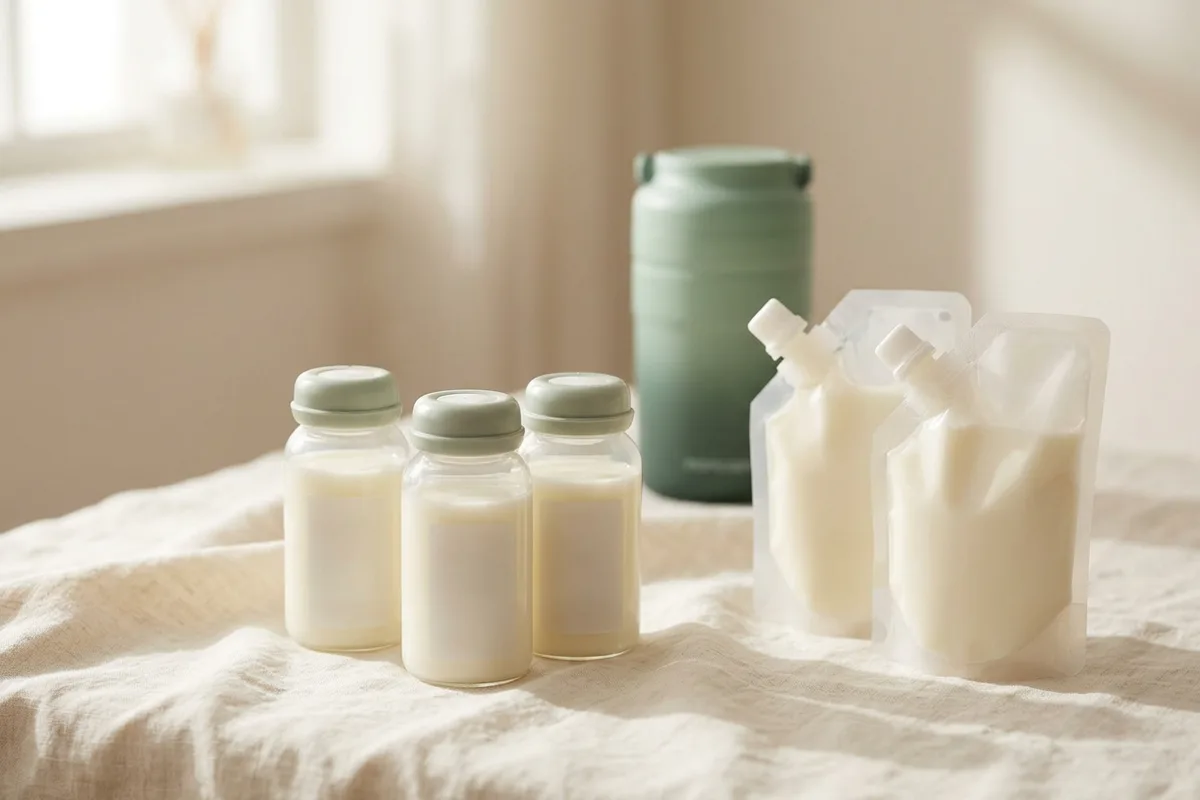
The container is a real decision, not a detail, because it changes how much freezer space you burn and how fast milk thaws. The CDC's rule for the vessel is simple: use clean food-grade glass or hard BPA-free plastic bottles with tight lids, or breast-milk-specific storage bags — and it warns against ordinary household sandwich or freezer bags, which aren't designed for milk and can leak or split.
Bottles (glass or hard plastic) suit milk you'll use within a few days: reusable, easy to clean, leak-proof, and they pour straight into a feeding setup. The downside is they're bulky in the freezer and cost more upfront if you need a dozen.
Storage bags win for freezing a stash. They're pre-sterilized, single-use, and — crucially — they lie flat, so they freeze thin, thaw fast, and stack like files to save space. The trade-off is running cost and the classic mess of tearing a corner to pour, which is why a spout design is worth the small premium.

Momcozy Spout Breastmilk Storage Bags
Pre-sterilized, double-zip bags that lie flat to freeze thin and thaw fast — with a spout that pours into a bottle without the messy tear-corner.
Check price at Momcozy →Whatever you choose, two storage habits from the CDC apply to both: store in small portions — 2 to 4 ounces, or whatever your baby takes in one feeding — to avoid thawing more than you'll use, and leave a little headroom in bags and bottles because milk expands as it freezes. Filling a bag to the brim is how you end up with a split seam and a freezer to mop.
Labeling and rotation
This is the cheapest, highest-leverage habit in the whole system. The CDC's instruction is plain: clearly label breast milk with the date it was expressed. Use waterproof ink or a freezer-safe label, and write the date on every bag and bottle — then rotate "first in, first out" so the oldest dated milk gets used before it ages past the window. (Add your baby's name if it's going to daycare.) And mind where you store it: the CDC says not to keep milk in the fridge or freezer door, because every door-open warms the contents. Push it to the back, where the temperature is coldest and most stable.
Storing milk on the go: coolers and travel
The guidelines assume you're near a fridge. Real life — the commute home, the day out, the flight — often isn't, and the CDC has a specific answer for that gap: if you can't get expressed milk into a refrigerator or freezer right away, store it in an insulated cooler bag with frozen ice packs, and it will keep for up to 24 hours that way; move it into the fridge or freezer, or use it, as soon as you arrive. That single line is why a dedicated milk cooler earns its place in a pump bag — a good one holds a couple of bottles snugly against an ice pack so the milk genuinely stays cold for the trip, not just "cool-ish."

Momcozy Portable Baby Bottle Cooler (12oz)
An insulated 12oz cooler with an ice pack that keeps a bottle cold on the move — the practical version of the CDC's "insulated cooler bag with ice packs" rule for travel.
Check price at Momcozy →One caveat with any cooler: it buys you that 24-hour window only while the ice packs stay frozen and the bag stays closed — so keep the packs fully frozen and open it as little as you can.
How to choose storage gear that lasts
If you're buying once and getting it right, here's the chemist's checklist. Material: glass or hard BPA-free plastic bottles; pre-sterilized, food-grade bags — never repurposed kitchen bags. Seal: a double-zip or screw lid you trust, because a freezer leak ruins the bag below it too. Portion size: containers sized for 2–4 oz so you thaw only what you'll use. Freezer footprint: flat-freezing bags stack; round bottles don't. For travel: insulation plus a real ice pack. Match the gear to the window you need — fridge-for-days, freezer-for-months, or cooler-on-the-move — and you'll waste far less of the milk you worked to express.
Frequently asked questions
According to the CDC, freshly expressed or pumped breast milk keeps at room temperature — defined as 77°F (25°C) or colder — for up to 4 hours, and the clock starts when you finish pumping. If your baby won't be fed within that window, refrigerate or freeze it. Milk that has already been thawed or warmed has a shorter limit of just 2 hours at room temperature.
The CDC says freshly expressed breast milk lasts up to 4 days in the refrigerator (at about 40°F / 4°C) and, in the freezer (about 0°F / -18°C), is best used within about 6 months, though up to 12 months is acceptable. Frozen milk older than six months is still safe up to a year — it just gradually loses some nutrients and fat quality. Store milk at the back of the fridge or freezer, never in the door, where temperatures swing most.
No. The CDC's guidance is that thawed breast milk should never be refrozen. Once milk is thawed in the refrigerator, use it within 24 hours; once it's been warmed or brought to room temperature, use it within 2 hours. This is why it helps to store milk in small 2-to-4-ounce portions and thaw only what your baby will take in one feeding, so you're never forced to discard a large thawed batch.
No — the CDC says never to thaw or heat breast milk in a microwave, because microwaving can destroy nutrients and create hot spots that can burn a baby's mouth (microwaves heat unevenly, so a bottle can feel only warm outside while a pocket inside is scalding). Instead, set the bottle or bag in a container of warm water, swirl gently to mix the separated fat, and test a few drops on your wrist before feeding.
Both work, and many parents use both. The CDC recommends clean food-grade glass or hard BPA-free plastic bottles with tight lids, or breast-milk-specific storage bags, and warns against ordinary household sandwich or freezer bags. Bottles suit milk you'll use within a few days because they're reusable and leak-proof; storage bags are better for freezing a stash because they lie flat, freeze thin, thaw quickly and stack to save space. Leave a little room at the top of either, since milk expands as it freezes.
The CDC says that if you can't get expressed milk into a refrigerator or freezer right away, you can store it in an insulated cooler bag with frozen ice packs for up to 24 hours, then move it to a fridge or freezer or use it promptly when you arrive. A dedicated insulated milk cooler with a proper ice pack — like the Momcozy portable cooler in this guide — is the easiest way to hit that 24-hour window on a commute, a day out or a flight. Keep the ice packs fully frozen and the bag closed to make it last.
Storage is one piece of the pumping puzzle — if you're still choosing your gear, start with my complete breast pump buying guide for how to pick the right pump type, and if you've landed on hands-free, see my pick of the best wearable breast pumps. And if pumping itself feels slow or uncomfortable, it's usually flange size, not the pump. Get the pump, the fit and the storage right together and the routine gets a lot less stressful.